
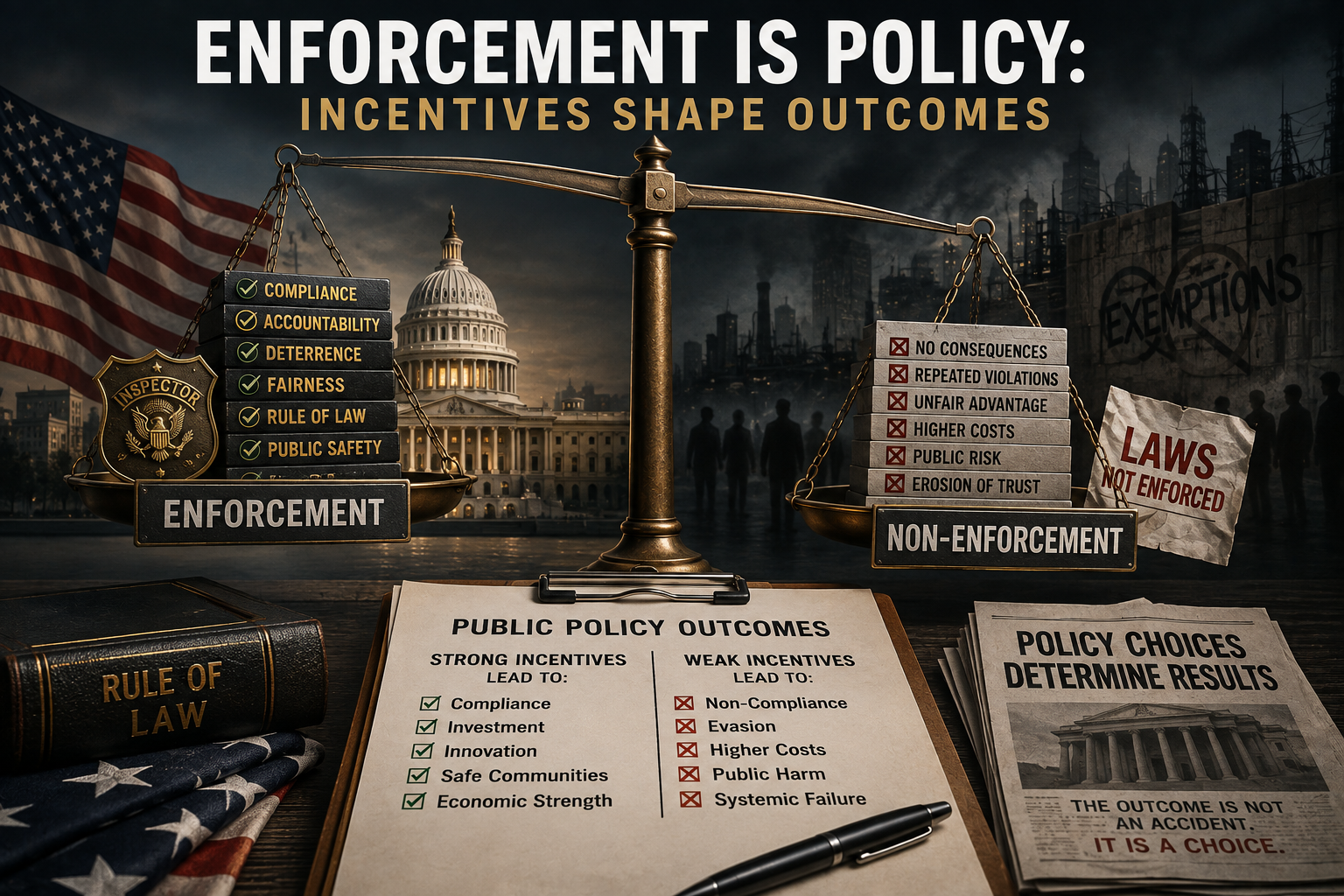
Immigration enforcement is often discussed as if it begins and ends at the border. In practice, enforcement policy extends far beyond ports of entry and patrol operations. It also includes the incentives created by employment access, benefits, state and local cooperation, interior enforcement priorities, and the credibility of legal consequences.
Those incentives matter because policy does not operate only through written rules. It also operates through expectations.
Incentives Shape Behavior
When laws are enforced consistently, individuals and institutions adjust their behavior accordingly. When enforcement is uncertain, delayed, selective, or routinely waived, the expected cost of violating those rules declines.
That principle is not unique to immigration. It applies broadly across regulatory systems, taxation, licensing, criminal law, and commercial compliance. Immigration policy is no different.
Employment Is a Central Incentive
For many migrants, access to employment is one of the most powerful incentives affecting migration decisions. That makes employer-side enforcement a central component of immigration policy.
If unauthorized employment is widely available and penalties are perceived as unlikely or inconsistent, the labor market itself can become a pull factor. Conversely, credible employment verification and meaningful enforcement can alter those incentives without relying exclusively on physical border measures.
State and Local Policy Also Matters
Although immigration authority is primarily federal, state and local policies can influence the practical environment in which immigration law is enforced.
Cooperation policies, licensing rules, public-benefit eligibility, local enforcement practices, and information-sharing arrangements can either reinforce or weaken federal enforcement objectives.
Credibility Is Part of Enforcement
A legal system depends not only on the existence of rules but on public confidence that those rules will be applied consistently.
When enforcement priorities change dramatically from one administration to another, institutions and individuals may begin to treat the law as temporary or politically negotiable rather than durable.
That weakens institutional credibility and encourages behavior based on anticipated non-enforcement rather than on the law itself.
Policy Is More Than Statutory Language
Formal statutes establish legal authority, but executive discretion, agency priorities, funding decisions, prosecutorial policies, and administrative practice determine how much of that authority is actually exercised.
For that reason, enforcement itself becomes policy.
The practical question is not simply what the law permits or prohibits. It is whether the incentives created by actual enforcement practices reinforce or undermine the stated objectives of the law.