
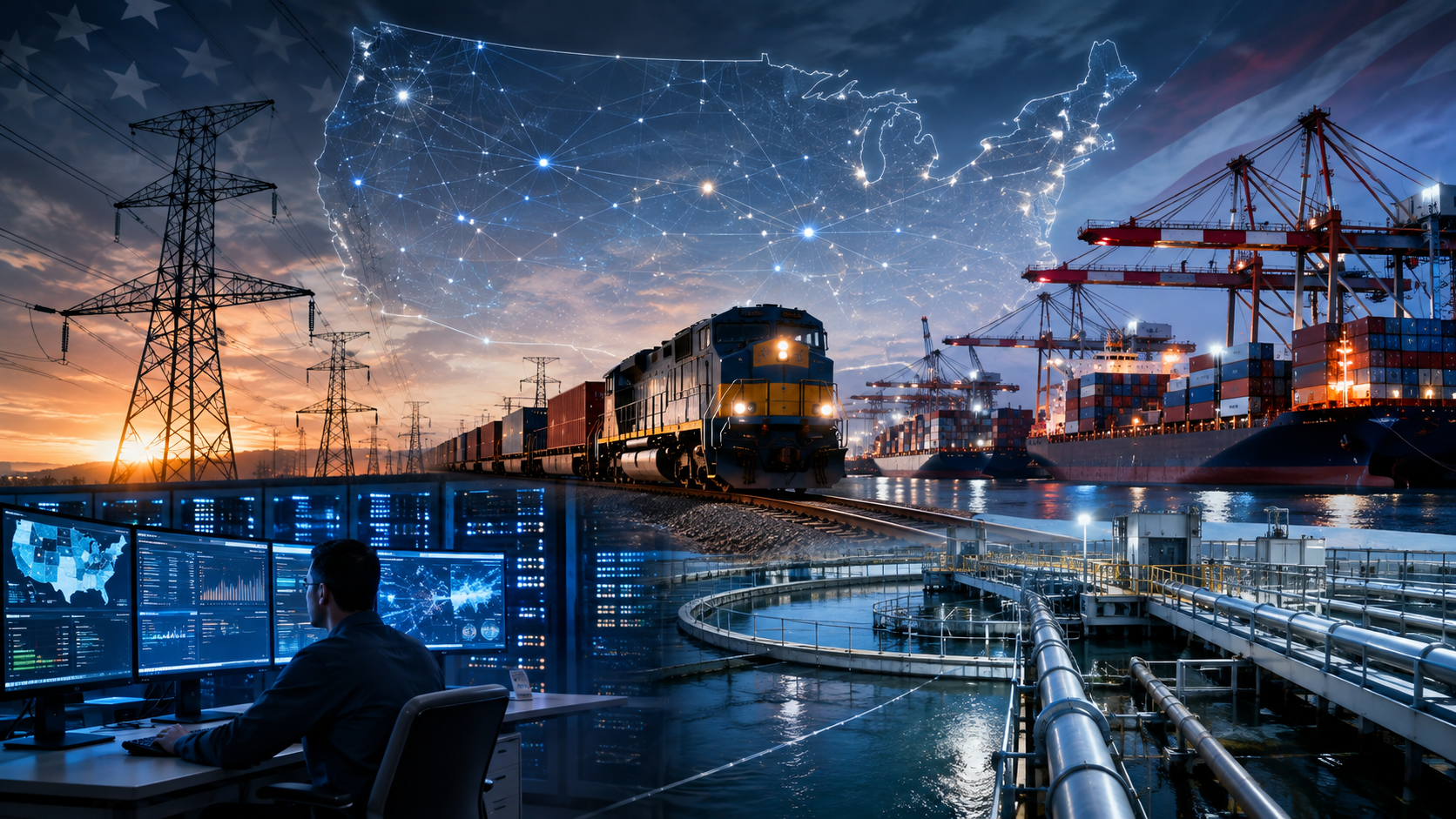
Critical infrastructure is often discussed as if it were a single national system under centralized government control. It is not.
America’s energy networks, communications systems, transportation hubs, financial infrastructure, water systems, manufacturing capacity, and digital networks are governed through a mix of private ownership, public regulation, state authority, federal oversight, and international supply chains.
Energy
The electric grid is operated through a combination of investor-owned utilities, public utilities, cooperatives, independent system operators, regional transmission organizations, and state and federal regulators.
Generation, transmission, fuel supply, transformer availability, and grid-control equipment each present different dependencies and vulnerabilities.
Communications
Telecommunications infrastructure is overwhelmingly operated by private companies, but national security concerns extend well beyond carrier ownership.
Network equipment, software, undersea cables, satellites, cloud infrastructure, data centers, and foreign-manufactured components all affect the resilience of communications systems.
Transportation and Logistics
Ports, railroads, airports, trucking networks, pipelines, warehouses, and maritime shipping form the physical backbone of domestic commerce and military mobility.
Disruption in one major transportation node can produce consequences well beyond the facility itself, particularly when alternative routes or domestic capacity are limited.
Water and Public Systems
Water and wastewater systems are highly decentralized. Thousands of local governments, authorities, and utilities operate facilities with widely varying budgets, technology, staffing, and cybersecurity capabilities.
The fragmented structure can complicate national coordination while placing significant responsibility on local operators.
Digital Infrastructure
Cloud services, enterprise software, industrial control systems, semiconductor supply chains, and cybersecurity providers increasingly underpin every other critical-infrastructure sector.
A disruption originating in a digital supplier can therefore propagate into energy, transportation, finance, government, healthcare, and communications.
Ownership Is Only Part of the Question
National resilience cannot be measured solely by asking whether infrastructure is American-owned.
An American company may rely on foreign equipment, overseas manufacturing, imported minerals, foreign shipping, internationally distributed software development, or suppliers concentrated in a small number of countries.
Control, therefore, includes ownership, operational authority, technological dependence, supply-chain concentration, and the ability to restore essential systems after disruption.
The Sovereignty Test
The central national-security question is whether the United States can maintain essential services during war, economic coercion, cyberattack, natural disaster, or major supply-chain disruption.
A sovereign nation does not need to manufacture every component domestically. It does need sufficient visibility, redundancy, trusted supply, and recovery capacity to ensure that essential systems cannot be disabled through a small number of external dependencies.